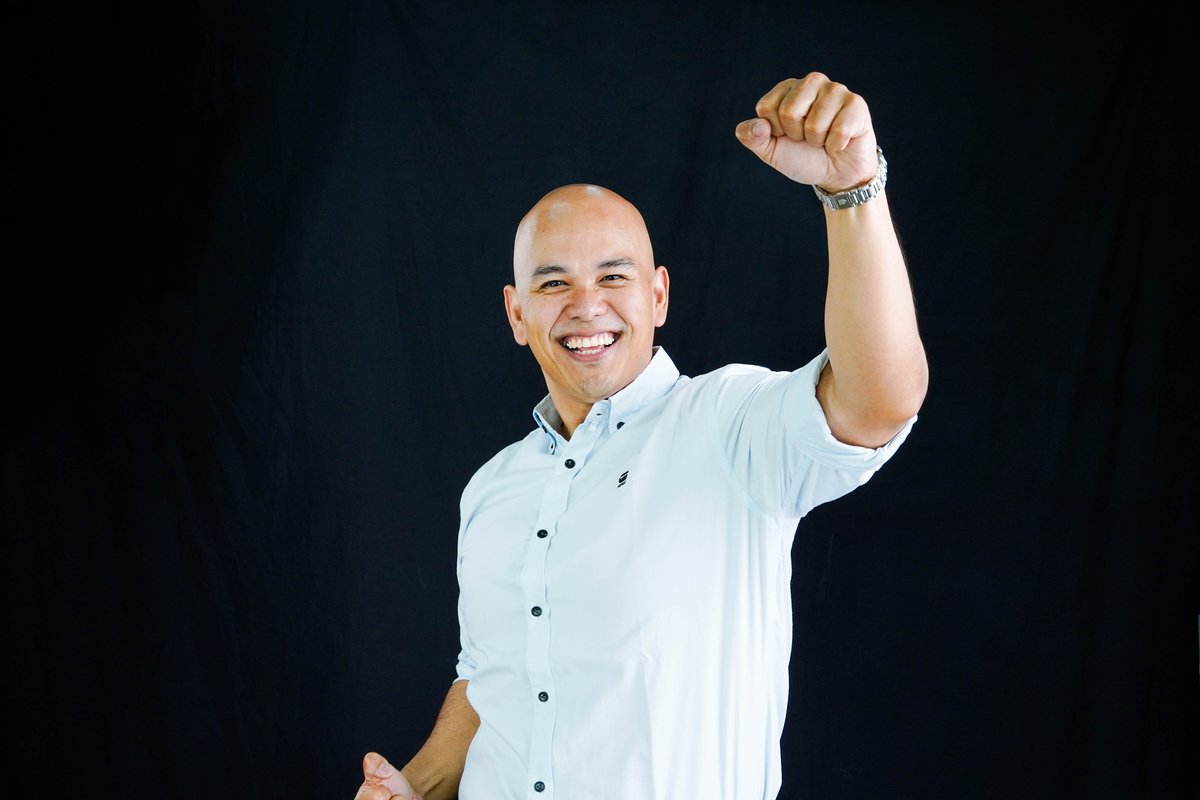
Stages show you the crowd. Mentorship shows you the person. After thousands of one-on-one and small-group sessions with young Indonesian entrepreneurs over more than a decade, I've come to see a set of truths that no keynote or workshop could ever reveal — the actual mechanics of who breaks through, who gets stuck, and why.
This is what I learned in the rooms that nobody else was in.
The Differentiator Isn't Intelligence. It's Relationship with Feedback.
The clearest predictor I've found of which young entrepreneur will genuinely grow is not how smart they are, not how motivated they sound, and not the quality of their idea at the start. It is how they receive difficult feedback.
Some people hear feedback and immediately process it — not always immediately accepting it, but genuinely metabolizing it, turning it over, integrating it. Others hear feedback and immediately defend. Their response to "this part isn't working" is to explain why it actually is. Their response to "this assumption might be wrong" is to marshal evidence that it's right.
The defenders are not bad people. They are often the most passionate, the most invested, the most capable. But their relationship with being wrong is so costly to their self-image that feedback arrives as a threat rather than as information. Changing that relationship — or finding ways around it — is often the most important work in a mentorship.
"I stopped measuring potential by what someone could build. I started measuring it by what they could hear."
The Loneliness of the First-Generation Entrepreneur Is Real — And Rarely Acknowledged
One thing that consistently emerges in close mentorship that almost never surfaces in public settings: how genuinely alone first-generation entrepreneurs feel in Indonesia. Not lonely in a social sense — they're often surrounded by people. Lonely in the sense that nobody in their immediate circle truly understands what they're doing or why.
Their parents worry. Their friends don't quite get it. They can't talk to their partners about their cash flow anxiety without causing alarm. They can't admit self-doubt to their team without undermining confidence. They perform competence and certainty constantly, with no real outlet for the uncertainty that is actually running in the background.
This isolation is dangerous. It leads to worse decisions — because the feedback loops are broken — and to burnout that nobody sees coming because nobody was told about the pressure that was building. One of the most consistent things I try to do in mentorship is simply create a space where that performance can drop, where someone can say "I actually don't know what I'm doing" and have that be received without judgment and without alarm.
What They Think They Need vs. What They Actually Need
Young entrepreneurs almost always come to mentorship asking for tactical help: how do I raise funding, how do I find the right co-founder, how do I scale my marketing. These are real questions and deserve real answers. But in my experience, the tactical question is usually a proxy for a deeper one.
"How do I raise funding?" often means: "Is what I'm building actually worth anything?" "How do I find the right co-founder?" often means: "I'm terrified to do this alone but I don't know if I can trust anyone." "How do I scale my marketing?" often means: "I've been working this hard and the results feel invisible and I need someone to tell me if I'm doing this wrong or if I need to keep going."
The mentors who give only tactical answers are still valuable. But the ones who can hear the question underneath the question — and address both — are the ones whose mentorship actually changes something.
Three Habits That Separate Breakthroughs from Plateaus
Across thousands of mentorship interactions, certain patterns appear reliably in the entrepreneurs who break through versus those who stay stuck at the same level for years. These are not rules — they're observations. But they've held up long enough that I believe they're meaningful.
They make decisions before they feel ready. Entrepreneurs who consistently break through have developed a tolerance for acting on incomplete information. They don't wait until they're certain — they get clear enough, then move. Entrepreneurs who plateau often have a very high bar for certainty before action, which in practice means they rarely act at all on the things that matter most.
They actively seek out people who are harder to impress than them. The entrepreneurs who grow fastest are constantly putting themselves in rooms where they are clearly not the most experienced person. They find peers and mentors who operate at a level above them and expose themselves to that standard regularly. Those who plateau tend to remain in circles where they are already respected — which feels good but rarely challenges.
They treat reversals as information, not verdicts. A failed product launch, a partnership that fell apart, a quarter where everything went wrong — these are experienced differently by entrepreneurs who break through versus those who don't. The former process them quickly and extract what's learnable. The latter tend to carry them as evidence about their own fundamental limits. This is not a personality trait — it is a skill that can be developed.
What I Wish I Had Known Before I Started
Looking back on my own journey and through the lens of everything I've seen in mentorship, the thing I wish I'd understood earlier — and that I see most young entrepreneurs discover too late — is this: the work is not the obstacle. You are. Not as a deficiency, but as the thing that most needs to be developed.
The technical challenges of building a business are solvable. There are templates, playbooks, advisors, capital, and information for every tactical problem you will face. What there are no templates for is the particular version of fear, ego, self-doubt, and blind spots that you specifically carry — the psychological architecture that was built before you ever thought about starting a business, and that now shapes every decision you make without your awareness.
The most important work in entrepreneurship is not building the product. It is building the person who is capable of building the product — and then sustaining it, scaling it, and leading others through the inevitable difficulty that follows. Mentorship at its best is precisely that work.
Looking for a Mentorship Structure That Actually Works?
TES mastermind programs are designed to provide the close-up guidance, peer accountability, and safe space for real conversations that most young entrepreneurs never get. Limited cohorts, serious commitment.
Learn About TES Mentorship ↗ More Articles